

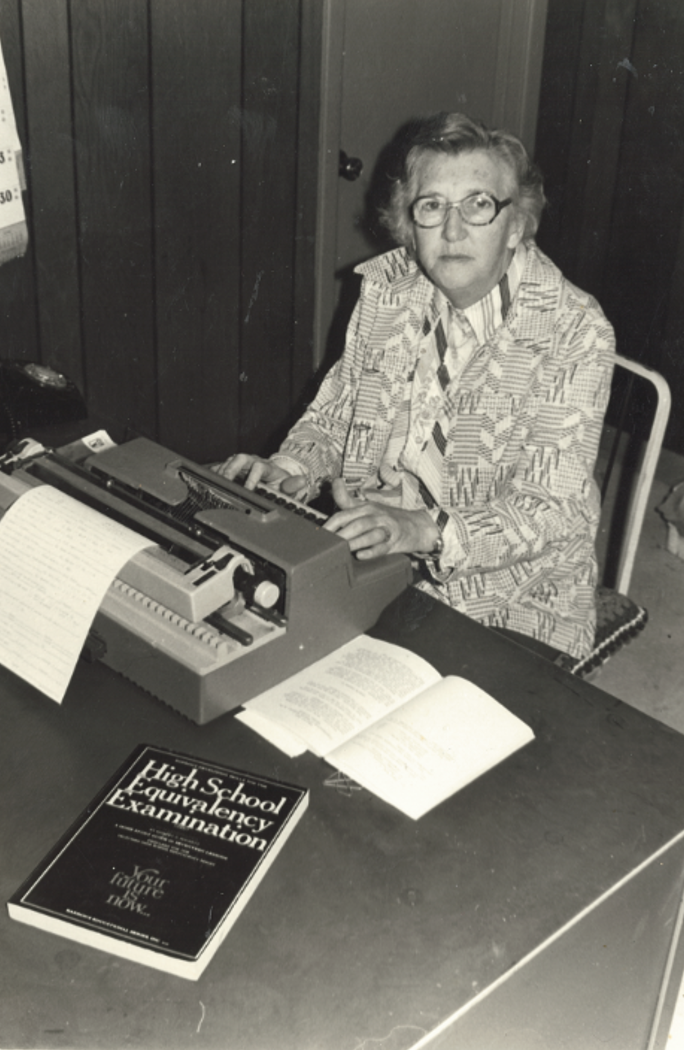
My great-grandmother Goldie, who earned her GED later in life, won the Marshall County Commission Volunteer of the Year for her work tutoring adults seeking their GED in the 1980s.
When I speak, you immediately know where I’m from. You can gather a lot about me from my speech. You can tell about my culture, my experiences, and the different identities I hold. My voice reveals a lot if you just listen a little bit. I haven’t always liked how I sound though. I was told from a young age that “Ain’t ain’t a word,” and that I “wasn’t fixing to do nothing.” Phrases that were handed down to me by my family elders weren’t standard practices of English although I knew exactly what they meant. “Isn’t” and “about to” were proper and should always replace “ain’t” and “fixing to”, especially in formal school settings.
I was told later by a professor when completing my teacher education program that I should move out of the south for a few years to lose my accent and that I would never be taken seriously in academia if I didn’t speak standard English. I was prompted to change my speech so that I would sound “more intelligent” and be able to get into rooms I otherwise wouldn’t have been allowed entry. If I didn’t mold my voice into a key, doors of accomplishment and actualization were slated to remain shut and locked tight.
I started to think even more about language when I graduated and started teaching elementary school in an urban district. I was asked by an administrator how I could expect to teach reading and writing and language arts with proficiency if I couldn’t even speak proper English. I was left a little embarrassed and more intentional in both my pronunciation and enunciation, acknowledging to myself that rejoindering was not worthwhile.
Despite this, I began to teach, first at a school in the city and later at the school I attended as a child. I taught and listened to students read every day. I listened not only to every sentence and word, but every sound in every word. Every sound they uttered sounded just like mine and the words of my family and friends and those of my community. It was the sound of the people I loved most. When I listened to them read and speak and express their thoughts and ideas about the world, I started to think about how hard it must have been for my daddy’s grandmother Goldie to learn to read when she was only able to go to school until the sixth grade.
How many teachers spent the time listening to her read? How many teachers sat and appreciated every vowel and consonant she spoke? Unanswered nonetheless, everything pales in comparison to the pure fact that my daddy had sure admired her sound when he would spend the night with her in her little block house and she would tell him stories of their beloved family.
How hard would it have been to have to quit school to support your family? How different would my own life have been if my mama and daddy hadn’t had the means to prioritize my education above all other things in life and what would it have meant to my generations past if the generations before would have had the means? Goldie’s husband, Pa Thorton, never having attended school, had taught himself to read from the family Bible at night after working the farm.
What an immense privilege it was to have my parents sit with me and read to me and let me learn from them. Even if my speech was considered imperfect and flawed, there was good intent in the teachers, professor, and administrator that appraised my sound. Although I am seated that language expression is never a moral failing, I understand the worry that my sound might limit the chances in life that I would get.
I am one to believe that the critiques I received are not reflective of the character of my fellow educators and they deserve no condemnation simply because they were working to protect my future opportunities. But I can’t help to think about how different it would be for those children I was with, attending the same school that generations of my family were too poor to either attend or finish, to have their sounds appreciated and affirmed. Much like all my admonishers, I desperately want those children to finish school and be able to wholeheartedly pursue education and have a better life than their generations before them, just as I am.
I am now thinking about how I can use how far I have come to do some advocating for these children and all those of my community. Because of this, I don’t dislike my sound anymore. I’m proud of my sound. My sound and my voice have become one. Every time I speak now, I get to hear the sounds of those people that I love so much and am reminded how much they sacrificed so that I am able to pursue my dreams. I get to hear the voices of students that need my voice, that need my sound, which is comprised of the voices of so many others, to speak for their futures and believe in them to better themselves and their families and their communities.
When you meet me, you might not be able to hear all that in my sound. You can’t determine what my purpose is from just my speech, but you can hear it loud in my voice. You have to listen to what I have to say; my voice reveals a lot if you just listen a little bit. I have always had my sound, but I haven’t always had the voice to articulate what was in my heart and how deeply I felt about change for my family and my community.
Further pursuing my education is how a lot of that has come about for me. My graduate program at Clemson University and the dear colleagues and friends I have made here have helped me develop my voice in ways I never imagined possible. While studying higher education now, I get to hear the voices of so many other people who dream of the same world. We may not sound the same, but I know our hearts, purposes and values align without any of us having to utter a sound. I will get to bring back the voices of my program and of this learning to my community, and my community will be better because of that. I am better because of Clemson. My voice is clearer and stronger because of the people that are here.
With my voice, I will end with some words of Reverend Martin Luther King, Jr. The Reverend King said, “Life’s most persistent and urgent question is, What are you doing for others?” When you hear my voice, I pray that you not only hear the sounds and needs of my people, but the righteous embrace of all our collective lived experiences. I ask you to consider how your own voice can amplify this.
Author Biography
Jayme Snider (she/her) is an K-20 educator, research-practitioner, leader, and lifelong learner with a passion for improving interdisciplinary curriculum design, experiential and contextual learning approaches, and rural education from North Alabama. Jayme is currently pursuing a Master of Education in Counseling with a concentration in Student Affairs at Clemson University.